Vesica

렌즈형 (베시카 피스키스)

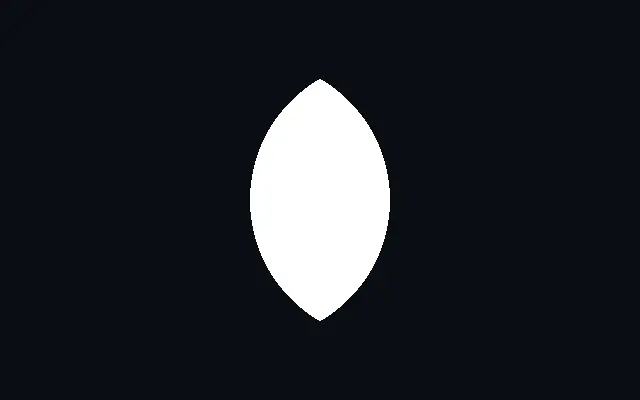
A lens-shaped intersection formed by two overlapping circles.

Also known as: VesicaVesica piscisLens shape

Moves in browsers that support WebGPU

This device could not render the demo — showing a still

React
// Renders only in browsers with WebGPU.
import { Shader, Vesica } from 'shaders/react'

export default function ShaderEffect() {
  return (
    <Shader style={{ width: '100%', height: 320 }} disableTelemetry>
      <Vesica />
    </Shader>
  )
}
Vue
<!-- Renders only in browsers with WebGPU. -->
<script setup lang="ts">
import { Shader, Vesica } from 'shaders/vue'
</script>

<template>
  <Shader style="width: 100%; height: 320px" :disable-telemetry="true">
    <Vesica/>
  </Shader>
</template>
Svelte
<!-- Renders only in browsers with WebGPU. -->
<script>
  import { Shader, Vesica } from 'shaders/svelte'
</script>

<Shader style="width: 100%; height: 320px" disableTelemetry>
  <Vesica />
</Shader>
Solid
// Renders only in browsers with WebGPU.
import { Shader, Vesica } from 'shaders/solid'

export default function ShaderEffect() {
  return (
    <Shader style={{ width: '100%', height: '320px' }} disableTelemetry>
      <Vesica />
    </Shader>
  )
}
JavaScript
// Renders only in browsers with WebGPU.
// expects <canvas id="canvas" style="width:100%;height:320px"></canvas> on the page
import { createShader } from 'shaders/js'

const shader = await createShader(document.getElementById("canvas"), {
  components: [
    {
      type: 'Vesica',
    }
  ]
}, { disableTelemetry: true })

Props · Vesica

Changes apply to the demo above and to the code tabs. Descriptions come from the library registry (MIT).

NameValueDefaultRange / optionsDescription
originOriginSet in codecenter—Reference edge the center position is measured from (center default). Lets you pin the shape relative to a corner or the canvas centre.
colorColor#ffffff—Fill color of the vesica
centerCenter
x0.5y0.5
{"x":0.5,"y":0.5}x, y: 0 – 1Center position of the vesica
radiusSize0.350.05 – 1 (step 0.01)Radius of the two overlapping circles
spreadSpread0.50.05 – 0.95 (step 0.01)Circle separation — 0 = full circle overlap, 1 = infinitely thin lens
rotationRotation00 – 360 (step 1)Rotation in degrees
softnessSoftness00 – 0.1 (step 0.001)Edge softness for antialiasing
strokeThicknessStroke Thickness00 – 0.2 (step 0.005)Stroke thickness. Zero means no stroke.
strokeColorStroke Color#000000—Color of the stroke outline
strokePositionStroke Positioncenteroutside · center · insidePosition of the stroke relative to the shape edge
colorSpaceColor Blendinglinearlinear · oklch · oklab · hsl · hsv · lchColor space for blending fill and stroke colors

Every component also takes blendMode · opacity · visible · maskSource/maskType · boundingBox · id

Vesica piscis keeps only the lens-shaped area where two circles overlap. Its pointed ends and convex sides make it useful as a mark for overlap or balance.

`radius` sets the radius of both circles from 0.05 to 1. `spread` controls their separation from 0.05 to 0.95: smaller values overlap more, while larger values make the lens thinner. Use `rotation` from 0 to 360 degrees to turn it, and `softness` from 0 to 0.1 to soften its edge.

A high `spread` makes a narrow lens that may disappear at small sizes. Layer it with `Ellipse` to emphasize its direction, or place it with `Crescent` to compare outlines created from overlapping circles.

When to use

Use it for an overlap mark, lens-shaped badge, or balanced abstract pattern. Its overlap width can draw attention to the center. Avoid it when you only need a full circle or a thin line.

Open as page ↗