Worley Noise

워리 노이즈

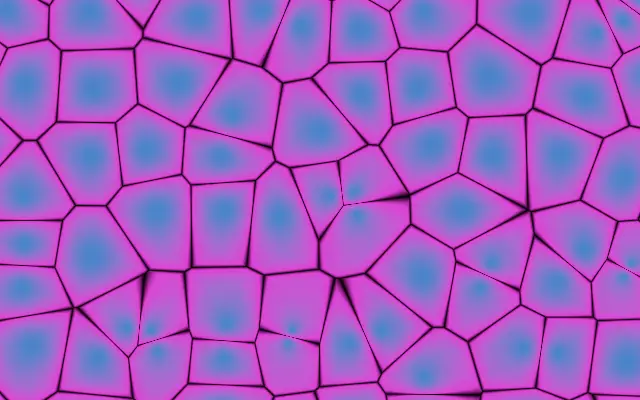
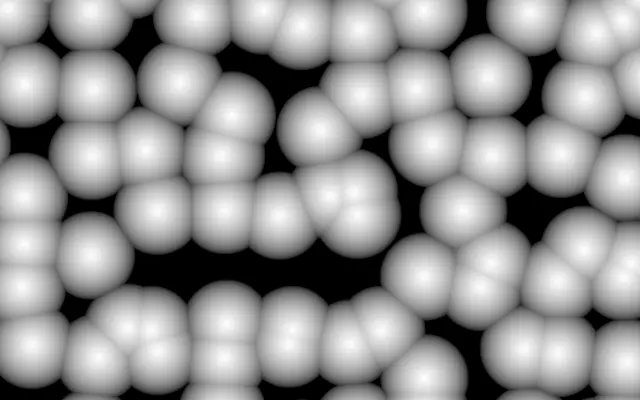
A cellular field that maps distance from scattered points to color, with selectable cell and edge patterns.

Also known as: WorleyNoisecellular noisecell noise

Moves in browsers that support WebGPU

This device could not render the demo — showing a still

React
// Renders only in browsers with WebGPU.
import { Shader, WorleyNoise } from 'shaders/react'

export default function ShaderEffect() {
  return (
    <Shader style={{ width: '100%', height: 320 }} disableTelemetry>
      <WorleyNoise />
    </Shader>
  )
}
Vue
<!-- Renders only in browsers with WebGPU. -->
<script setup lang="ts">
import { Shader, WorleyNoise } from 'shaders/vue'
</script>

<template>
  <Shader style="width: 100%; height: 320px" :disable-telemetry="true">
    <WorleyNoise/>
  </Shader>
</template>
Svelte
<!-- Renders only in browsers with WebGPU. -->
<script>
  import { Shader, WorleyNoise } from 'shaders/svelte'
</script>

<Shader style="width: 100%; height: 320px" disableTelemetry>
  <WorleyNoise />
</Shader>
Solid
// Renders only in browsers with WebGPU.
import { Shader, WorleyNoise } from 'shaders/solid'

export default function ShaderEffect() {
  return (
    <Shader style={{ width: '100%', height: '320px' }} disableTelemetry>
      <WorleyNoise />
    </Shader>
  )
}
JavaScript
// Renders only in browsers with WebGPU.
// expects <canvas id="canvas" style="width:100%;height:320px"></canvas> on the page
import { createShader } from 'shaders/js'

const shader = await createShader(document.getElementById("canvas"), {
  components: [
    {
      type: 'WorleyNoise',
    }
  ]
}, { disableTelemetry: true })

Props · WorleyNoise

Changes apply to the demo above and to the code tabs. Descriptions come from the library registry (MIT).

NameValueDefaultRange / optionsDescription
colorAColor A (Low)#ffffff—Color where the noise field is low (typically near cell centers)
colorBColor B (High)#000000—Color where the noise field is high (typically near cell boundaries)
colorSpaceColor Spacelinearlinear · oklch · oklab · hsl · hsv · lchColor space for color interpolation
scaleScale61 – 30 (step 0.5)Number of cells across the canvas at the base octave
modeModef1f1 · f2 · f2MinusF1 · f1PlusF2 · f1TimesF2Field type. F1 = distance to nearest point. F2 = distance to second-nearest. F2 − F1 emphasises cell boundaries.
distanceDistanceeuclideaneuclidean · manhattan · chebyshevDistance metric. Euclidean = round cells. Manhattan = diamond. Chebyshev = square.
octavesOctaves11 – 4 (step 1)Number of fractal layers stacked at progressively finer scales
lacunarityLacunarity21.5 – 4 (step 0.1)Scale multiplier between octaves (only active when Octaves > 1)
persistencePersistence0.50 – 1 (step 0.01)Amplitude multiplier between octaves (only active when Octaves > 1)
jitterJitter10 – 1 (step 0.01)How much each cell's point drifts inside its cell. 0 = rigid grid (banded look), 1 = fully random.
contrastContrast10.25 – 4 (step 0.01)Steepness of the gradient between low and high regions
balanceBalance0-1 – 1 (step 0.01)Shifts the gradient midpoint. Negative pulls the field toward Color A, positive toward Color B.
seedSeed00 – 100 (step 1)Random seed — shifts the cell pattern without changing its overall structure
speedSpeed0.50 – 5 (step 0.1)Animation speed — how fast each cell's point drifts

Every component also takes blendMode · opacity · visible · maskSource/maskType · boundingBox · id

Its connected cell borders resemble soap bubbles or fractured stone. The shape of each cell stays more visible than in noise made of smoothly blended patches.

`scale` defaults to 6 and ranges from 1 to 30; higher values fit more cells across the canvas. `mode` defaults to `f1`, the distance to the nearest point; `f2MinusF1` emphasizes cell borders. `distance` defaults to `euclidean`; `manhattan` makes diamond-like cells and `chebyshev` makes square ones. `jitter` defaults to 1 and ranges from 0 to 1: values near 0 keep points in a rigid layout, while values near 1 scatter them more freely inside each cell. `speed` defaults to 0.5 and ranges from 0 to 5; it controls how fast the cell points move.

This generator draws directly on the canvas and needs no input layer. Lower `speed` when you want the cell layout to hold still, and reduce color contrast when dense borders start to crowd the scene. Compare it with `Voronoi` for another view of cell boundaries.

When to use

Use it for cell, foam, or fractured-stone textures, cellular backgrounds, and abstract patterns with visible borders. Avoid it when you want nearly borderless cloudlike color blending.

Open as page ↗