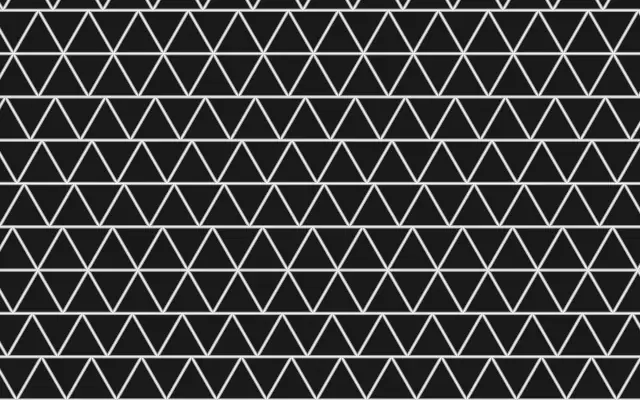
Like a tiled floor of triangles or a paper-folding diagram, equilateral triangles fit together across the canvas. Their angles give the pattern a different texture from square or hexagonal grids.
`cells` sets the number of triangle rows along the shorter canvas edge. Adjust line weight with `thickness` and direction with `rotation`. `variation` changes the fill brightness from triangle to triangle; increasing `speed` makes the rows drift horizontally.
`speed` defaults to 0, so the pattern stays still. It fills the canvas without an input layer; avoid very dense settings behind text or small icons, where the many edges can compete for attention.
When to use
Use it for geometric backgrounds, graphics that suggest folding or architecture, or a subtle sense of movement in a static scene. Avoid it where dense triangle edges would overlap body copy.