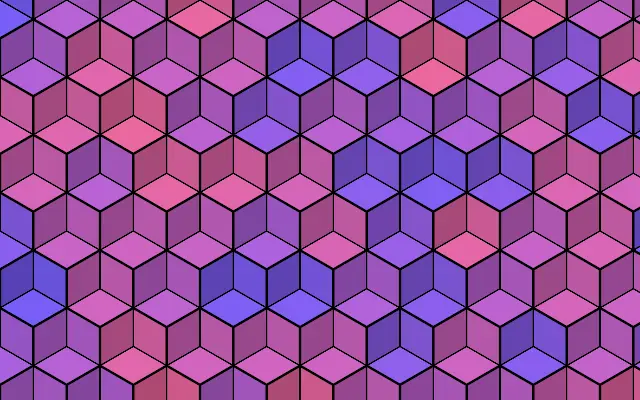
It looks like cubes stacked across a flat game map or isometric illustration. Differently colored faces and edge lines suggest depth without requiring a 3D model.
Increase `cells` for smaller cube tiles. The two colors supply the cube faces; set `colorVariation` to 0 for uniform cubes, or raise it to vary them more from cube to cube. `thickness` changes the edge lines, and `rotation` turns the tiling.
The tile pattern fills the canvas without an input layer. `colorVariation` defaults to 1, so cube colors can vary. Dense faces and edges can compete with text; use a lower cell count or softer color contrast for a background.
When to use
Use it for isometric game maps, product or technology illustrations, and geometric backgrounds with a sense of depth. Avoid it when small labels or body copy would disappear among the lines and faces.