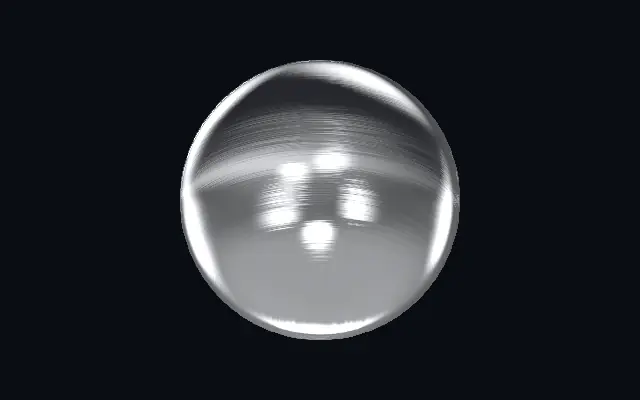
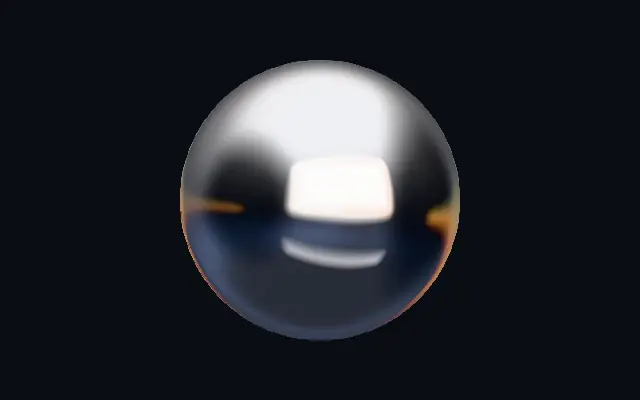
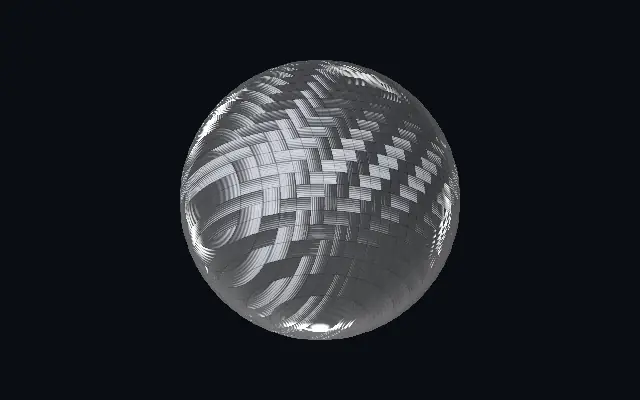
Strength of the reflected studio lighting — the softboxes seen smeared across the metal
envRotationEnv Rotation
0
0 – 360 (step 1)
Rotates the reflected studio — spins where the bright reflections fall
lightAngleLight Angle
215
0 – 360 (step 1)
Direction of the key light for the anisotropic specular streak, in degrees
speedSpeed
0.4
0 – 4 (step 0.01)
Speed of the slowly drifting reflection — the studio gently orbits the surface. 0 pauses.
bevelWidthBevel Width
0.05
0.005 – 0.2 (step 0.001)
Width of the edge bevel, relative to the shape — thin for machined jewellery edges, wide for soft pillowed metal
bevelShapeBevel Profile
0
0 – 1 (step 0.01)
Bevel profile — 0 = one smooth round fillet, 1 = machined: a steep outer fillet, a chamfer plateau and an inner knee, each catching its own line of light
edgeSoftnessEdge Softness
0.05
0 – 1 (step 0.01)
Softness of the shape boundary edge
shapeShape
Set in code
{"type":"sphere3D","radius":0.35}
—
Serialized shape configuration (JSON)
shapeSdfUrlshapeSdfUrl
Set in code
—
URL to a pre-generated SDF .bin file
shapeTypeshapeType
Set in code
—
Active SDF shape type
Every component also takes blendMode · opacity · visible · maskSource/maskType · boundingBox · id
Like a hairline-finished metal sheet seen at an angle, fine grain runs in one direction and stretches reflected light into long streaks.
`brushAngle` turns the grain direction. Raise `anisotropy` to lengthen reflection streaks along the grain; `grain` changes the depth of the fine scratches. `roughness` moves the finish from crisp polish toward soft matte.
The material creates its own surface. A plain backdrop lets the grain read clearly; fine grain can compete with small lettering.
When to use
Use it for device frames, product or car panels, and restrained metallic typography. Avoid it where small text must stay clear or visible grain would distract.